12Days

Annapurna Circuit Trek - 12 Days

392 reviews
97 reviews
Customize Trip
Duration
12 Days
Trip Grade
Moderate
Country
Nepal
Maximum Altitude
5,416 M
Group Size
2 to 15
Starts
Kathmandu
Ends
kathmandu
Activities
Trekking
Best Time
Sep- Dec & March-June

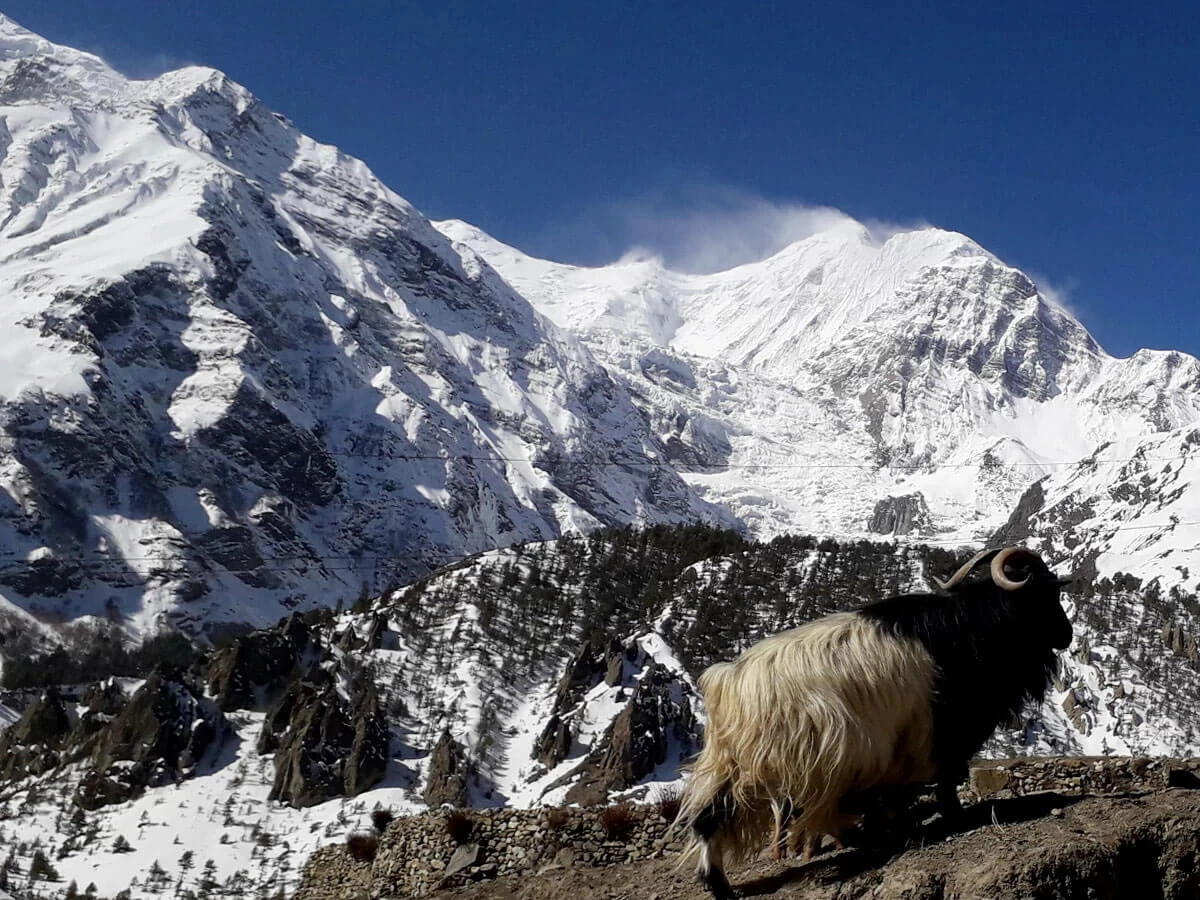
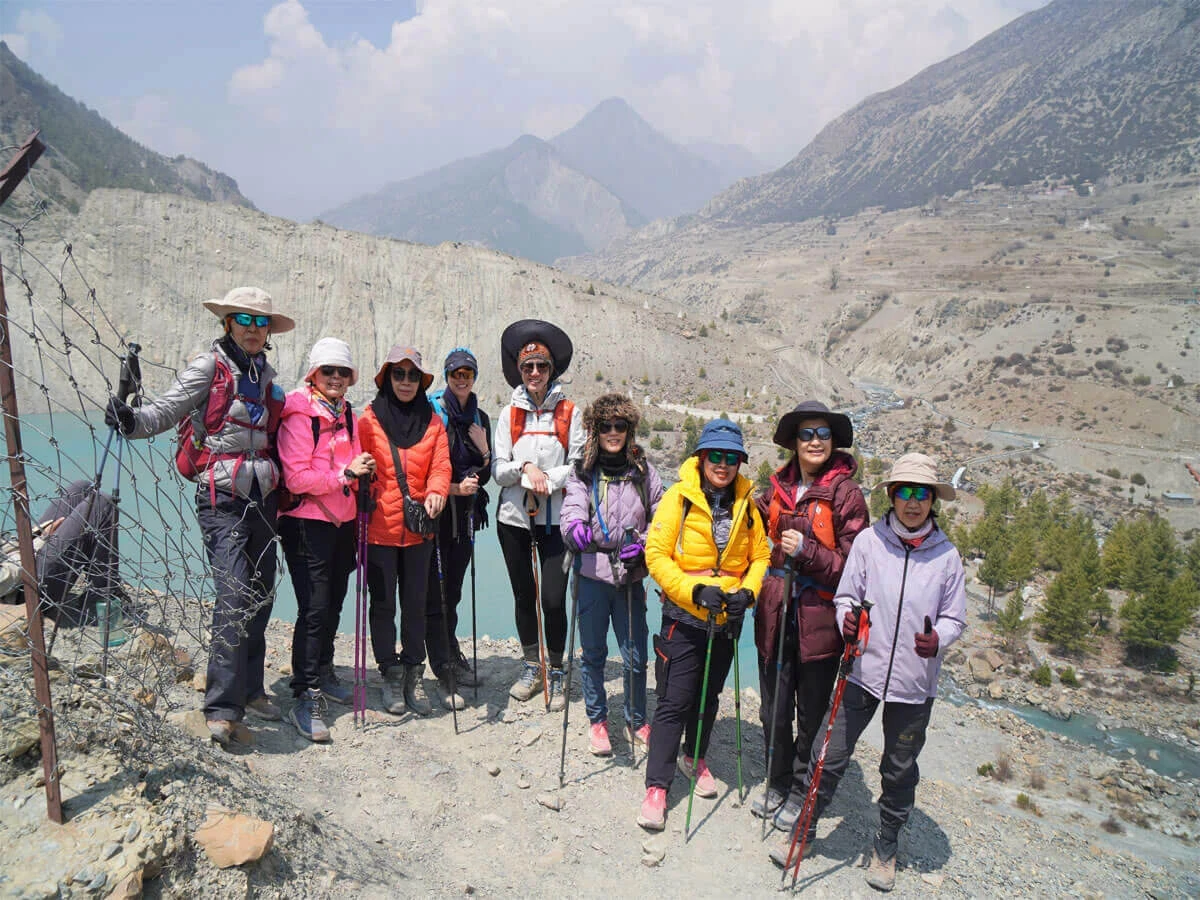
The Annapurna Circuit Trek is a classic trek in Nepal, presenting the aesthetic views and sights of the Annapurna region. It showers you with a myriad of fascinating conventions, mores, and modes of living. Multiplicity of Annapurna ranges, Nilgiri, Tilicho Peak, and Gangapurna among others, are real magic for the eyes to witness. Trek through rhododendron-laden tracks to far-flung villages and settlements. Encounter religious cloisters, chortens, and Gumbas scattered across the land. Walk under the Annapurna panorama as you cross high mountain passes and cover 80–85 km (50–53 miles) from the Dharapani, starting point of our Annapurna Trekking, to Muktinath. This classic trek is regarded as a moderately challenging journey, perfect for even novice trekkers. We, the Index Adventure Agency, present you with the best of Nepal, the Annapurna Circuit, in only 12 days.

Nepal Annapurna Circuit - A Moderate Trek

The Annapurna Circuit follows a splendid trail that goes through dense semi-tropical regions. Most noteworthy, experience the elation of changing landscapes decorated with striking natural pulchritude at every daring step. Likewise, enjoy the highland spectacles of the region and bask in the thrill of crossing fascinating mountain passes like the Thorong La. Circumbulate the region to expose yourself to thrilling mountain passes like no other! It is a journey that is rich in natural and Himalayan beauty, as well as the ethnic culture of the indigenous people. It is a journey that demands a visit at least once.

A moderate trek, the Annapurna Circuit Trek is characterized by its opulent Himalayan beauty at all times. From the twigs of the trees ornate with banners of colorful blessings to the religious chortens and Mani-walls that lie across the trail. The Annapurna round-trip is sure to be monumental.

Trek through the Manang Valley, a stunning Himalayan basin, and visit the sacred pilgrimage site of Muktinath Temple. Cross the high Himalayan pass of the Thorong La and bask in the natural beauty of the Kali Gandaki Gorge (The deepest one). Experience the richest-caste of Nepal, the Thakali people, in Jomsom.

Why Annapurna Circuit Trekking?

The Annapurna Circuit Trek also takes you to the famous lake-side city of Pokhara. Moreover, the journey is filled with fascinating terrains and equally fascinating ethnic Tamang, Gurung and Magar culture. Enjoy the views of mountain peaks like the Chulu range, Gangapurna, the Tilicho Peak, Kangraru Himal, and the Thorong Peak among many others. Likewise, the Thorong La Mountain Pass is the highest mountain pass in the world!

  • Cross over Thorong La Pass, one of the world’s highest mountain passes
  • Witness dramatic changes in the terrain from luscious woodland, alpine desert, to snowy boundaries
  • Explore Green Lake (Miring Tso), a secluded alpine treasure
  • Experience Manang’s Tibetan culture, yak herders, and prayer-flagged villages
  • Taste local apple pie, fresh juice, and dried slices
  • Enjoy locally made mountain delicacies from Thakali dal bhat to tsampa porridge
  • Spot rare wildlife in the Annapurna Conservation Area.

Discover the Gems with Expert Annapurna Circuit Trek Agency

Annapurna Tilicho Lake Trek

Looking for a more comprehensive and rewarding experience with side detours in the Annapurna Region? Then look no further; we present you a 15-day classic circuit route with a side trip to Tilicho Lake, a fabulous glacial lake and the world's most gorgeous high-altitude lake.

Nar and Phu Valley Trek with Annapurna

For a richer, off-the-beaten-path, and authentic experience, choose the isolated trail to Nar Phu Valley. We take a different path from Koto to reach this place. The Valley is inhabited by Tibetan settlers, also known as Khampas. Most of them are Ghale, Gurung, and Lama. Interact with the locals and know their way of life.

No matter which itinerary or how long days you choose, either you craft it and make it a Short Trek or Classic Annapurna with a touch of Ghorepani Poon Hill or side detours that few know. The Index family, a local trekking Agency of Nepal, is ready to arrange your itinerary, accommodations, and tours, making them flexible for you.

Why are we the best trekking agency for Annapurna Circuit Trek?

We provide a secure, well-planned, and genuinely unforgettable trip from beginning to end, which makes us the greatest company for the Annapurna Circuit Trek. Thoroughly experienced licensed guides and well-thought-out trekking itineraries, combined with stringent safety standards, mean you can trek with confidence, even at high altitudes.

Our round-the-clock assistance, acclimatisation and local insights signify you don’t need to worry about any aspect of your trek. We are transparent in our pricing, no hidden charges and we put in the extra effort to ensure your journey is hassle-free and memorable. We assure you a safe and enjoyable Annapurna Circuit trek with us.

Annapurna Circuit Trek - 12 Days Itinerary

Annapurna Circuit Trek Itinerary

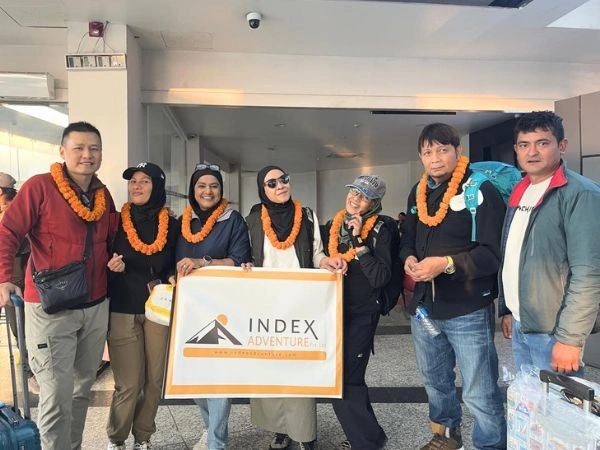
Your adventure in the Annapurna Circuit Trek starts as you arrive at Tribhuwan International Airport. One of our staff will be there to greet you and then take you to the hotel in Kathmandu. After a short meeting, you can have the rest of the evening to unwind or explore the local markets near your hotel.

Now, you'll take a scenic drive to Dharapani. You'll start your hike from Dharapani to Chame. Further, you'll trek to Pisang, passing through beautiful landscapes and villages along the way.

As you continue, you'll reach Manang. Here, you'll take a day off to acclimate to the high altitude and explore the area. Subsequently, you'll trek to Yak Kharka, where you'll spend the night before heading to Thorong Phedi.

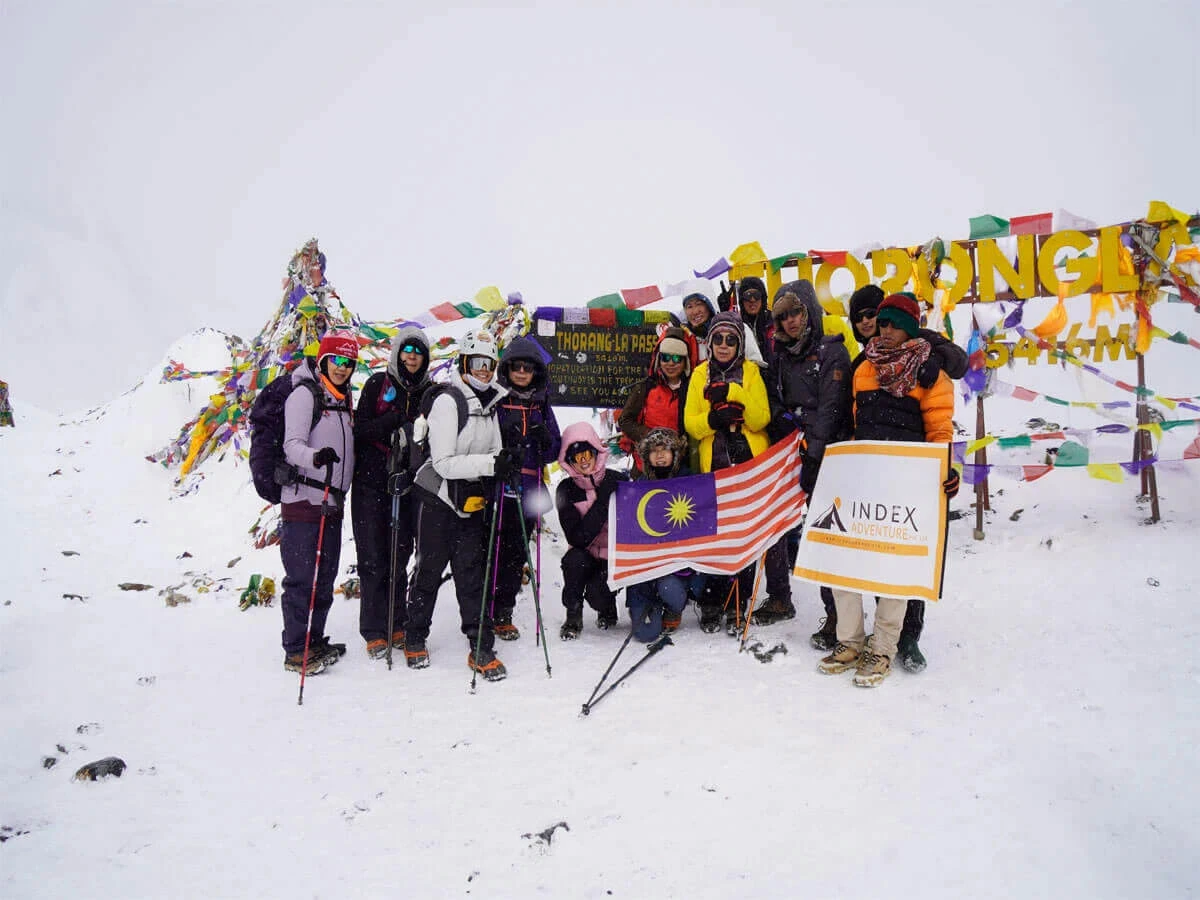
From there, you'll cross the Thorong La Pass, which sits at an elevation of 5,416 meters. It's an intense hike that will take about 7-8 hours, but the views from the top are worth it!

After crossing the pass, you'll head to Jomsom, where you'll spend the night before driving to Pokhara. On day eleven, you'll take a flight from Pokhara to Kathmandu and bring your trip to a close.

cta
Customize and Book Trip
Embark on a journey of discovery with us: Index Adventure gives you unforgettable holiday experience.
Customize Trip

Cost Details

Includes

  • International airport pick up and drop off by private vehicle.
  • 2 Nights 3-star Hotel in Thamel, Kathmandu with BB Plan.
  • 1 Night accommodation in the Standard Hotel in Pokhara, BB Plan.
  • Public bus ticket from Kathmandu to Besishahar.
  • Sharing JEEP ticket from Besisahar to Dharapani.
  • Public bus ticket from Muktinath to Pokhara.
  • Tourist bus ticket from Pokhara to Kathmandu.
  • 8 nights' Trekking lodge / Teahouse accommodations during the trek(twin sharing).
  •  3 times meals a day (Breakfast, Lunch, and Dinner), a cup of tea or coffee during the trek.
  • Government register expert with a professional English-speaking trekking guide, including accommodation, food, transportation, equipment, and salary.
  • All necessary paperwork and Annapurna National Park entry permit, Trekker’s Information Management System (TIMS), including local Tax, Government tax & official expenses.
  • ­(if needed) Sleeping bag, down Jacket & Duffel Bag (to be returned after trip completion).
  • Duffle bag, and a company T-shirt (complimentary).
  • Free luggage storage at the Index Adventure Store.
  • ­Farewell Dinner & Trekking Achievement Certificate.
  • Exclusive Medical Kit Bag.

Excludes

  • International airfare, all kinds of travel insurance, and the Nepal visa fee. (You can apply online, or you can easily issue the visa on arrival at the International Airport in Kathmandu. ( For a Nepal Visa, 15 days - $25-30, 30 days- $40-50and 90 days- $100-110).
  • Extra nights' accommodation & lunch, and dinner in Kathmandu  & Pokhara city.
  • Personal expenses such as all kinds of drinks, hot showers, battery charging, extra meals, and wifi laundry.
  • Travel and rescue insurance (necessary).
  • Additional Costs or delays caused due to Circumstances beyond our control. Example: bad weather conditions, landslides, illness of government policies, strikes.
  • Porter to carry your luggage during the trek. Please, if you would like to take a porter, you can check our Add-ons Details option.
  • Tips for guides and porters.

Add-ons & Options

With us, Index Adventure, the Annapurna Circuit Trek 12-day journey carries quiet gifts along the way—small touches, deeply rooted in care. Our add-on services aren’t surplus; they’re gentle hands that steady your path, warm moments around shared tea, and local wisdom that opens the trail like a conversation, making your Annapurna Circuit Trek premium.

Each offering is chosen not to impress—but to hold space for you to feel the adventure of Annapurna more fully, more closely, more truly.

Porter Service – US$230: Let our experienced porter carry your load, so you can wander freely and take in the beauty around you. One porter can be shared between two trekkers, carrying a total of up to 25 kg (55 lbs).

Kathmandu to Dharapani via Private Jeep – US$280: Enjoy a relaxing ride back to Kathmandu in a private jeep. Each jeep fits up to 6 passengers.

Private Jeep from  Muktinath to Pokhara  – US$200: Kickstart your trip in style with a private jeep—easy, comfortable, and built for the bounce. Each jeep fits up to 6 passengers.

Flight from Jomsom to Pokhara -US$170 per person (Flight Time 15 minutes).

Flight from Pokhara to Kathmandu -US$106 Per Person (Flight Time 20 minutes).

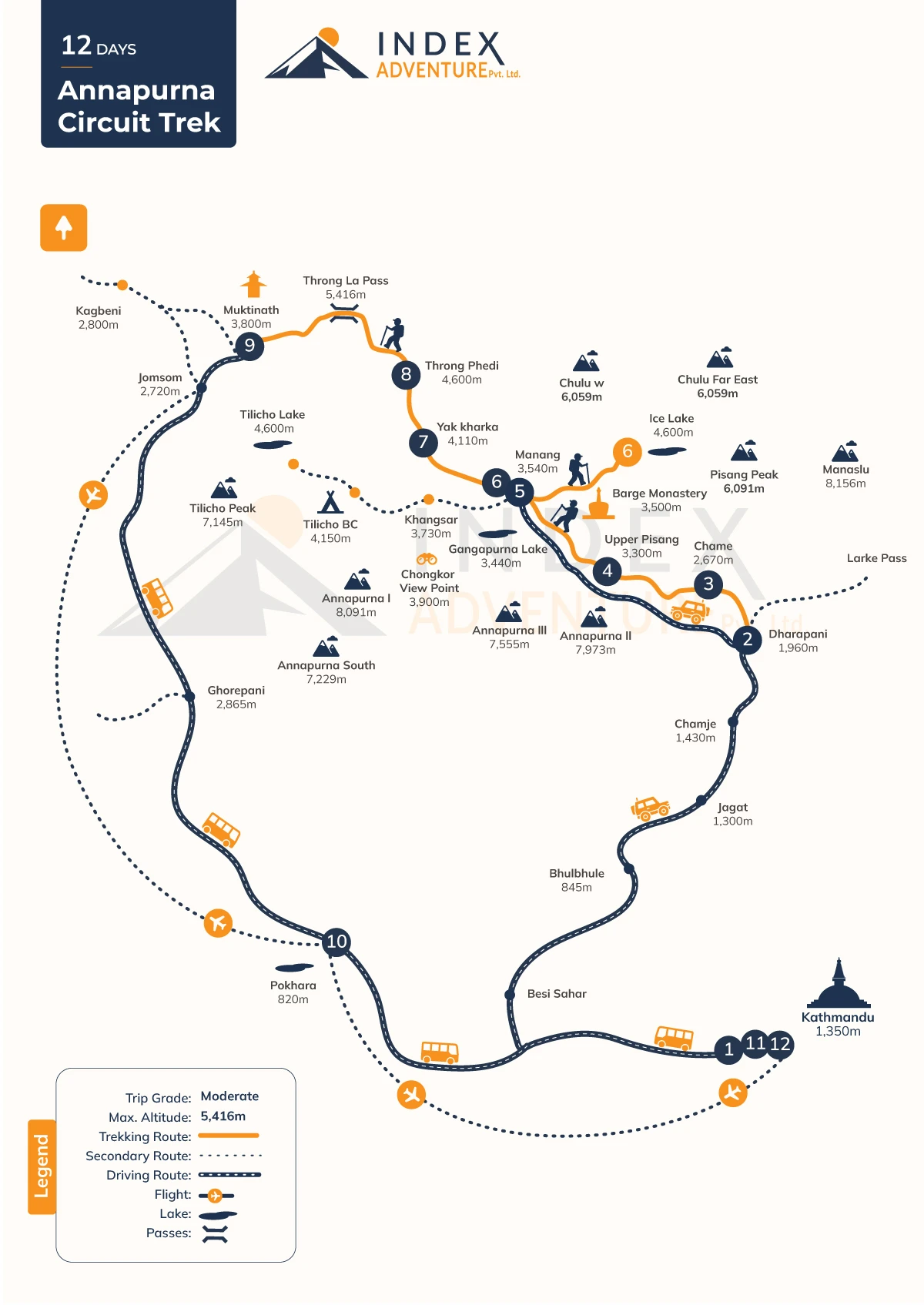
Annapurna Circuit Trek - 12 Days Route Map

Annapurna Circuit Trek - 12 Days

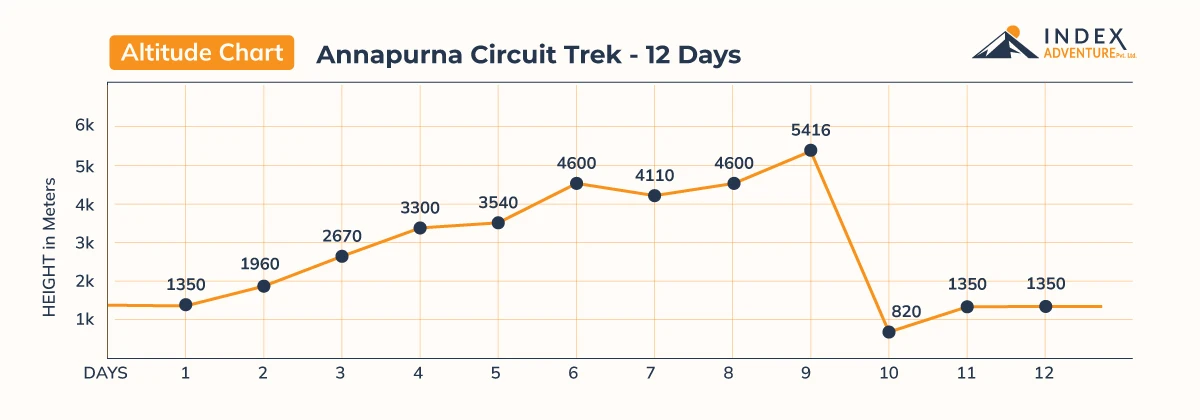
Altitude Chart

Annapurna Circuit Trek - 12 Days

Dates & Availability

Select your preferred date
May 2026
Jun 2026
Jul 2026
Aug 2026
Sep 2026
Oct 2026
Date:May 18, 2026 - May 29, 2026
Days:12 Days
Status:Guaranteed
Price:US$985
Date:May 20, 2026 - May 31, 2026
Days:12 Days
Status:Guaranteed
Price:US$985
Date:May 22, 2026 - Jun 02, 2026
Days:12 Days
Status:Guaranteed
Price:US$985
Date:May 24, 2026 - Jun 04, 2026
Days:12 Days
Status:Guaranteed
Price:US$985
Date:May 26, 2026 - Jun 06, 2026
Days:12 Days
Status:Guaranteed
Price:US$985
Date:May 28, 2026 - Jun 08, 2026
Days:12 Days
Status:Guaranteed
Price:US$985
Date:May 30, 2026 - Jun 10, 2026
Days:12 Days
Status:Guaranteed
Price:US$985

Essential Information

Manang Annapurna Circuit - An Arcadian Haven

A popular rest day of the Annapurna Circuit stop, Manang. Located in Gandaki Pradesh of Nepal, and the northern part of the Annapurna region, specifically within the Annapurna Conservation Area Project. It is surrounded by Xizang (Tibetan Autonomous Region) to the north, Mustang (the 5th largest district) to the west, Kaski to the southbound, and Lamjung to the east. Some of the eminent monastery present in Manang are Braga Monastery, Milarepa Cave Monastery, and Pocho Gumba.

Monastery around Manang

Braga Gompa, an ancient monastery in the region, is assumed to be over tercentenary. The monastery houses an assortment of invaluable relics, including clay statues (figurines) of Buddhas and Lamas, and complete sets of Kangyur and Tengyur texts written in gold. , is a part of the Kagyu lineage of Tibetan Buddhism.

Another spiritual shrine associated with the mid-millennium age Tibetan Buddhist yogi and poet is Milarepa. This cave is said to hold the myth that Guru Milarepa spent 6 years musing in this gompa and attained enlightenment. Located just near the cliff of Braka Gompa and close to Mt. Annapurna, and a lauded detour for trekkers on the Manang Annapurna Circuit.

Hiking to the Ice Lake of Manang, Kicho Tal. This Tal is a gratifying diversion from Manang valley and a fruitful addition to our 12-day short Annapurna Circuit Trek. It is a challenging hike (10-12 km round trip) but holds the reward of a stunning high-altitude lake (often frozen) and panoramic views of the giants.

The Longest Acclaimed Thorong La Pass (5416m) - A Gorgeous Mountain Pass

The Thorong La Pass (5416m/17769m) is a significant and tough challenge of the trip, but it is the most-loved and beautiful pass in the Annapurna trekking region. It’s located between the Manang and Mustang districts. The trek can be started from both sides, but more than 80% of trekkers start from Manang; starting in a clockwise direction from Dharapani and ending at Muktinath due to altitude reasons. Mountain views of Annapurna ranges (II & IV), Gangapurna, Tilicho peak, Pisang Peak, Lamjung Himal, Chulu West, and Chulu East can be seen at first as we hike. As we descend Mount Dhaulagiri, Nilgiri, Hiunchuli, Thapa peaks, among others, become noticeable after the pass. Khatung Kang and Yakawa Kang peaks are the peaks that form the pass.

One surprising fact is that the mountain pass is even higher than Everest Base Camp (5,346m), but it is not as high as the EBC Trek. In ancient times, this pass was used as a Trading route between Nepal and Tibet; actively, it has become mainly a trekking route for travelers.

Nepal Tilicho Lake Trek-Highest Lake in the Globe

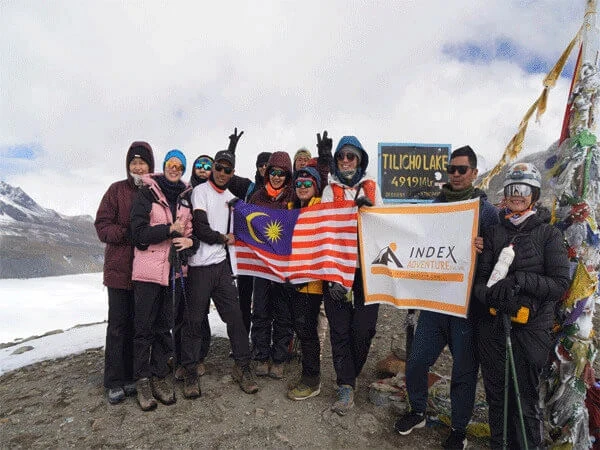
Tilicho Lake of Annapurna is a fabulous, frigid high-altitude lake in Nepal. Situated at 4,919 m high, it claims the fame of being the highest lake in the world after Ojas del Salado and surely for the jaw-dropping views. Tukuche, Manaslu, Hiunchuli, Dhaulagiri, fishtail, Annapurna South, I, II, III, and Tilicho Peaks are some of the prominent gigantic peaks seen from this site.

The Annapurna Circuit Trek is almost conducted throughout the year. But the best time to go is spring and autumn.

Spring (March, April & May) is one of the most popular times to go on this trek. With rhododendrons and wildflowers in full bloom, it’s the best time to experience nature at its best. This is also a perfect time to see local farming communities in full swing.

Autumn (September, October & November) is another best time to go trekking here. You can witness perfect weather with a moderate climate all around. You can witness Mount Annapurna perfectly during this time with clear skies and stunning panorama.

You can also go on this trek during the summer as well. If you want to see greeneries and wildflowers in their natural form then this might be the perfect time for you.

Avoid end of December to end of February for the Annapurna Circuit. Heavy snowfall can block passes and trails, making trekking unsafe and challenging.

Why is Annapurna Circuit Trek good for you?

  • It is one of the adventurous trekking routes in Nepal.
  • This trekking route is quite challenging for a person.
  • They have comfortable accommodations all over the route.
  • It is a perfect high-altitude hike for beginners.
  • Stunning and picturesque mountain views.
  • Witness rich culture and traditional experiences.
  • Experience diverse cultures, landscapes, terrains, and ecology.

Physical Fitness

As this route is quite challenging and strenuous, you have to be physically fit to go on it. It consists of difficult paths and steep trails. This trek will take you to an elevation of more than 5000 meters, so you might need to be physically and mentally sound.

Nepal Visa Information

It is important to note the details of the visa-acquiring process. Indians do not require a visa, whereas it is compulsory for all foreigners.

Requirements for the visa application are as follows:

  • You need a valid passport with at least six months left before it expires and a passport-size photo. Make sure it has at least one blank page for the visa stamp.
  • You must apply for your visa before reaching Nepal.
  • You can pay the visa fee with either cash or a credit card.
  • You can get a 30-day multiple-entry tourist visa by paying US $50 or its equivalent in foreign currency.
  • Another option is a 90-day multiple-entry tourist visa that costs US $135.
  • Online visa applications will remain in the system for only 15 days. The system will automatically delete it after 15 days. Thus, we recommend you submit the visa application only 15 days before your arrival date in Nepal.
  • People from Nigeria, Ghana, Afghanistan, Zimbabwe, Somalia, Cameroon, Swaziland, Iraq, Ethiopia, Liberia, and Palestine may not get visas on arrival at Tribhuwan International Airport. Please contact your local Nepalese embassy to complete your visa application process.
  • You can also contact the Nepal Embassy or Nepal Consulate in your country for prior information regarding visa requirements.

Arrival and Departure

Almost all countries are connected via air to Nepal. Once you arrive at the airport, our representative from Index Adventure will pick you up at the gate. They’ll drive you to your hotel and help with your check-in. Our package includes a 3-star hotel in Kathmandu for two nights. The hotel is within walking distance of all the major attractions.

After your trip concludes, you will be dropped off at the airport from the hotel for your departure.

Trekking Permits

To go on this trek, you’ll need special permits to enter this region:

  • Annapurna Conservation Area Permit (ACAP)
  • Trekkers' Information Management Systems (TIMS)

These Annapurna Circuit Trek permits are all included in your package so no extra charges will apply.

Trek Gears Preparation

For your Annapurna Circuit Trek with Index Adventure, pack sufficient hiking clothes due to no laundry services on the trail. Proper gear is essential for safety and comfort.

For a tailored packing list, check out our detailed guide.

Annapurna Circuit Trek Difficulty

The Annapurna Circuit Trek difficulty is regarded as moderate-to-challenging, 12 to 21-day trek covering approximately 160–230 km (100–145 miles), culminating at the 5,416-meter (17,769 ft) Thorong La Pass. It is physically demanding, featuring daily 5-8 hour walks, steep ascents, and high-altitude risks, requiring good cardiovascular fitness and proper acclimatization, usually with a rest day in Manang. 

Key Difficulty and Distance Metrics:

  • Total Distance: 160 km – 230 km (approx. 100–145 miles).
  • Duration: 12–21 days (typical itinerary).
  • Difficulty: Moderate to Challenging.
  • Maximum Altitude: 5,416m (17,769 ft) at Thorong La Pass.
  • Daily Walking: 5–8 hours.

Difficulty Factors:

  • Altitude Sickness: Risk is high above 3,500m. Proper acclimatization (e.g., in Manang) is crucial to avoid severe symptoms.
  • Terrain: The trail features varied terrain, including steep, rocky, and uneven paths.
  • Hardest Section: The crossing of Thorong La Pass, which involves a significant, high-altitude climb and steep descent.
  • Road Construction: New dirt roads have reduced the trekking distance on certain, lower sections of the route

Accommodation during the Annapurna Circuit Trek

During your overnight stay in Kathmandu and Pokhara, you’ll be accommodated in a 3-star hotel located in the tourist hub. It’s situated near shops, restaurants, currency exchange centers, banks, and ATMs.

While on your trek, you’ll find lodges along the way. They are usually family-run establishments and have a common form of accommodation. Rooms may consist of squat toilets or western-style toilets depending on the establishment.

They are basic and provide essential amenities, with most places having attached bathrooms and comfortable beds. It is recommended to carry a sleeping bag with you.

There is usually a wood fireplace in the dining or kitchen area, so you can stay warm during cold nights.

Meals during Annapurna Circuit Trek

Your breakfast is complimentary in Kathmandu and served buffet style inside the hotel. However, lunch and dinner are not included in Kathmandu, so you’ll have to arrange them on your own.

During the trek, your meals (breakfast, lunch, and dinner) are included in the package. You’ll be offered an assortment of dishes along the way. The most common is Dal Bhat (steamed rice with lentil soup) served with vegetables or non-vegetarian options, as well as vegan meals.

Note: If you’re allergic to anything or only eat gluten-free foods, you should inform your guide in advance. Get detailed information about what to have during Annapurna Circuit Trek.

Drinking Water Option on the Trek

You should drink at least 3 to 4 liters of water each day to protect your body from dehydration.

Even though plastic water bottles are available, we recommend against buying them. Safe drinking water stations are available at different places along the route. You can refill your bottles there.

You can also use purification tablets or portable filtration tools. Our guides will carry purification tablets, so you can ask them for assistance if you fill your bottle from natural springs or tap water.

Transportation to/from Kathmandu

Your drive starts from Kathmandu to Dharapani in a private vehicle. After your trek concludes, you’ll be transported to Pokhara from Muktinath via private jeep. From Pokhara, you’ll take a flight back to Kathmandu. The cost of all transportation is included in our package.

Acclimatization

We prioritize safety and follow all safety protocols. This trek can reach altitudes of up to 5,400 meters, so our itinerary includes an acclimatization day in Manang village. Our experienced guides will adjust the trekking pace according to your speed and stamina.

Trip Safety during Annapurna Circuit Trek

During this trek, our experienced guides with years of trekking experience will accompany you. In the event of an emergency, our guides are well-equipped to handle the situation and make informed decisions. Additionally, all our guides carry first-aid kits for immediate medical attention.

Internet & Mobile Network

The mobile coverage during Annapurna Circuit Trekking is quite good on this route. Network and internet infrastructure in this region are much better compared to many remote trekking areas. Wi-Fi is available in lodges, although it may be chargeable.

You can use SIM cards from providers like NCELL and NTC to buy internet packages. This is often cheaper than paying for Wi-Fi at every lodge.

You can buy SIM cards inside the airport or in Kathmandu. Make sure you carry a passport copy and a passport-sized photograph.

Electricity and Use of Travel Adaptors on the Trek

All lodges have electricity and you can charge your electronic devices there. However, charging facilities are limited and may not work sometimes due to technical difficulties.

The lodges usually charge an additional fee for charging electronic devices, and the price may vary from place to place. During peak season, you may have to wait because of high demand for charging stations.

We recommend bringing a power bank or backup battery pack in case of power outages or limited charging availability.

In Nepal, there are no flat-pronged wall outlets. The country mainly uses two-pin and three-pin plugs. The average voltage output varies between 220V to 240V with a frequency of 50Hz. We recommend carrying a universal travel adapter.

Hot Shower Availability

You can take hot showers in most lodges during the trek. In many places, you’ll need to pay an additional charge for hot water.

If you have a private room with an attached bathroom, showering is easier. However, if there is a shared bathroom, it can become crowded in the mornings since everyone usually wakes up around the same time.

We recommend carrying wet wipes as a backup option.

Money for the Trek

You can exchange or withdraw money in Kathmandu or Pokhara. There are very limited ATMs or banking facilities during the trek, so you’ll need to carry enough cash for the journey.

For personal expenses, approximately NPR 25,000 should be enough. You’ll need Nepalese Rupees for additional services such as showers, snacks, charging stations, internet/Wi-Fi, and drinks.

An ATM typically has a daily withdrawal limit of NPR 30,000 to NPR 50,000.

At the end of your trip, you may tip your guide and porter according to your satisfaction with their service.

Trekking Crew

We employ experienced guides and porters who are properly trained and licensed. Our guides have received training and mountain guide licenses from TAAN (Trekking Agencies Association of Nepal) and NATHM (Nepal Academy of Tourism and Hotel Management).

They have years of experience guiding both large and small trekking groups.

We also prioritize porter welfare. We ensure their loads remain within safe limits, provide fair wages, and support their training and family welfare.

Is Travel Insurance Needed for this Trek?

We strongly recommend proper travel insurance coverage for your trip to Nepal. Your insurance should include:

  • High-altitude rescue coverage up to 5,400 meters
  • Emergency evacuation services
  • Hospital costs
  • Accident and injury coverage

Please read all terms and conditions carefully before purchasing insurance.

Recommended Insurance Providers:

  • USA & Canada: Tugo, United Health Care, World Nomads, Blue Cross
  • Australia & New Zealand: Fast Cover, Allianz Australia
  • Singapore: Ergo, World Nomads (Explore Plan Level 3)
  • Europe: Europe Assistance, Austrian Alpine Club, Allianz Europe
  • India: ICICI Lombard

Disclaimer: These are only recommendations based on our experience. You may choose any insurance provider after reviewing the policy details carefully.

Private/Group Tours

At Index Adventure, we organize both private and group tours. A single-person private trek may incur additional costs, whereas a private trek for two or more people usually does not require extra charges.

Private tours are flexible and allow you to follow your own schedule while staying within the itinerary. Group tours may include 2 to 10 people from different countries, offering opportunities to meet and interact with fellow trekkers.

Trip Extensions

If you want to extend your trip beyond trekking, Index Adventure offers a variety of tour packages according to your interests.

You can extend your trip with leisure days in Pokhara, a wildlife safari in Chitwan, or sightseeing tours around Kathmandu Valley.

You can also enjoy adventure activities like bungee jumping, rafting, paragliding, or ziplining.

Responsible Travel

At Index Adventure, we promote responsible and sustainable trekking practices. We support local businesses and communities by prioritizing local tea houses, homestays, and service providers.

We also focus on environmentally friendly travel by minimizing plastic usage and encouraging reusable materials throughout the trek.

We strictly encourage trekkers to avoid littering and help preserve the natural beauty of the Himalayas.

Best places to visit on Annapurna Circuit Trek

The best places to visit on the Annapurna Circuit Trek include the high-altitude Thorong La Pass (5,416m), the sacred Muktinath Temple, and the scenic Manang village for acclimatization. Other top highlights include the turquoise Gangapurna Lake, the apple orchards of Marpha, and panoramic views from Poon Hill.

Key Highlights of the Annapurna Circuit:

  • Manang Village: A vital stop for acclimatization with close-up views of Gangapurna, Tilicho Peak, and Annapurna III.
  • Thorong La Pass (5,416m): The highest point of the trek, offering breathtaking Himalayan vistas.
  • Muktinath Temple: A significant holy site for both Hindus and Buddhists, featuring 108 water spouts and an eternal flame.
  • Upper Pisang: Offers stunning panoramic views of Annapurna II and a traditional, quiet mountain atmosphere.
  • Tilicho Lake (4,936m): One of the highest lakes in the world, often visited via a side trip from Manang.
  • Tatopani Hot Springs: A relaxing spot to soothe muscles after the strenuous hike, located near the Kali Gandaki River.
  • Marpha Village: Famous for its apple orchards, local apple brandy, and traditional white-washed houses.
  • Kagbeni: A fascinating, ancient Tibetan-style village serving as the gateway to Upper Mustang.
  • Chame: The district headquarters, known for its dramatic valley views, hot springs, and Apple orchards.
  • Ice Lake (Kicho Tal): A challenging side hike from Manang offering panoramic views of the Chulu and Annapurna ranges

What are the Best Tips for a Successful Annapurna Circuit Trek?

  • Prepare yourself physically and mentally 2 to 3 months before the trek.
  • Carry protein bars and dried fruits for extra energy during the trek.
  • Stay hydrated and avoid junk food, alcohol, expired snacks, and excessive dairy products.
  • Travel responsibly by avoiding bottled water and minimizing plastic use.
  • Follow your guide’s advice and take enough time for acclimatization.
  • If you experience symptoms of Acute Mountain Sickness (AMS), immediately inform your guide.
  • Explore Nepali culture and traditions through interactions with locals and guides.
  • Choose the best trekking season for clear mountain views and better weather.
  • Book early to secure better accommodation and trekking arrangements.
  • Appreciate your guides and porters with tips for their hard work and support.
  • Extend your trip with additional tours to Kathmandu, Bhaktapur, Patan, or Chitwan.

Thank you for considering Index Adventure for your upcoming adventure. We’re here to assist you every step of the way, so please don’t hesitate to contact us if you have any questions or need help finalizing your trip.

Equipments

Things to Pack for Nepal Trip and Trek

What should be on your packing list for trekking, in case you are going on an adventurous trekking tour to Nepal? Nepal boasts one of the most magnificent scenic views, spectacular mountains, and diverse cultures, making it a dream global trekking destination. Before trekking in Nepal, one needs to be well prepared because of the different terrains, weather conditions, and altitudes. In order to get the best out of your trekking visit, this ultimate packing guide of trekking in Nepal will cover all that is essential: a list of items you could carry with you, clothes, supporting trekking gear, hygiene, documents, etc.

Preparing to go trekking in Nepal can be very overwhelming, but with the right gear and equipment, you should be in a position to withstand anything that the path presents to you. This list is designed for popular treks, including Everest Base Camp, Annapurna Circuit, and Langtang Valley, among others. The list can be adjusted depending on the trek's difficulty and season. This latest and updated travel checklist to pack smart—and trek with confidence.

List of essential packing items

In the trekking, there are thousands of trekkers using costly fashion equipment, and they use outdoor fashion, but we advise you to be ready with hiking equipment that is comfy and sturdy.

  • Insulation Layer (Fleece/Down Jacket): Will be needed during cold weather.
  • Thermal Base Layers: Help to keep the body warm when it is cold or when it comes to high altitude.Your second actual skin; bring the highest quality (2 sets).
  • Fleece Pullover Hoodie: a garment that keeps you warm even when the water condenses on the inside when it is raining. Taking two, both at low-level and at high-level, comes in handy.
  • Lightweight Thermal Tops: This is cool when you do not wear a base layer.
  • Water, Rain, and Snowproof Outer Shell: recommended to use water, rain, and snowproof (in case of bad weather).
  • Hiking Shorts(Optional): They can be good in lower altitudes and on sunny days.
  • Hiking T-Shirt (2-3): convenient, breathable, fast-drying tops to wear every day. At a lower altitude.
  • Trekking Pants ( 2-3): Loose, comfy pants, flexible, to be comfortable on the trail. Lightweight, quick-drying paints (no jeans, please).
  • Down Pants: Bonus heat at night or at a high altitude trek.
  • Liner + Insulated Gloves: Cold hands will be kept warm and will be isolated from wind and snow. Should take two light ones and a heavyweight water/windproof. Cold hands will be kept warm and will be isolated from wind and snow.
  • Sports Bra for Girls: When you are hiking, a good sports bra should be considered.
  • Sportswear Underwear(5-7 pieces): Moisture-wicking to avoid annoyance and irritations. Quick dry.
  • Woolen Hat: This will come in handy when it is starting to get cold in the evenings and in the morning hours to keep your head warm.
  • Sun hat/ Cap: It protects one against the Sun at high altitude.
  • Neck Gaiter/ Buff: Very useful in the sun and dust or cold wind.

Footwear for Hiking in Nepal

  • Trekking Socks (3-5 pairs): These socks are meant to lower the possibility of blisters and visible processes that take a short duration to dry.
  • Warmer Socks (1-2): Wear during sleep or in an unfavorable climate in cold weather.
  • Trekking boots: A pair of sturdy, already used and comfortable, up-to-the-ankle boots made to provide support, traction, and repelling during mountainous and rough trail activities.
  • Trail Running Shoes: These are breathable and lightweight and are ideal when on more maintained paths or elevations, where the shoes do not need tough materials.
  • Camp Shoes/Sandals: It is convenient, comfortable, and wearing shoes that are worn to house overnight camp or river crossing after a strenuous day of trekking.
  • Gaiters (Optional): These cover over the boots so that one is protected against the snow or rain, or on muddy footpaths, dirt will not enter the shoes.
  • Crampon-compatible Boots: In case you are planning to trek into high-altitude or glacier-covered parts, then crampons are a must on icy surfaces that cannot be fitted into just any boot.

Gears and Equipment for trekking in Nepal

  • Packing a Backpack 30-50L on a personal basis: Its contents include items such as clothes, snacks, and water that may be carried around during the day.
  • Duffel Bag 70L: A Larger bag used to carry most of your equipment, which must be waterproof. It should be recommended only when you are going to use Porter.
  • Daypack with Rain Cover: A day pack is also essential on your trekking adventure in Nepal, regardless of whether you are carrying a porter or not. Day pack size recommendation is 25-30L with a rain cover, which keeps water and snow out of your pack and contents.
  • Sleeping Bag Liner ( -20 °C.): Also, it is highly advisable to bring your own after coming from a sleeping bag, and in case you plan to rent a sleeping bag. Insulates and makes your sleeping bag less in need of washing.
  • Trekking Poles: This is optional, though being knowledgeable of their use will help lessen the burden on the knees and enhance steadiness on inclined or uneven ground.

Accessories for trekking in Nepal

  • Extra Batteries Headlamp: These can be used on early morning walks, during power failure, or when one arrives late.
  • Water Bottles / Hydration Bladder: Makes you hydrated; it is easier to drink on the move as the bladder can be sipped from. Plastic waste can be reduced through the use of a reusable water bottle.
  • Water Purification Tablets or Filter: Garfores are the local sources used in providing safe drinking water.
  • UV Protection Sunglasses ( UV Protection): Cover the eyes against excessive sun and snow lights.
  • SPF 50+ sunscreen/SPF lip balm: Avoids sunburn and dry lips, too.
  • Towel (Quick-dry): To wash, or wipe at teasssshouses or streams.
  • Toiletries: (Eco-friendly): Toothbrush, toothpaste, a sheet of toilet paper, and biodegradable soap.
  • First Aid Kit (Personal): Covers the essentials of bandages, an antiseptic, altitude medication, pain relievers, and any particular medication you might need.
  • Snacks ( Energy Bars, Nuts, Chocolates ): Come in handy to provide instant energy when hiking hours are long.
  • Notebook and Pen (Optional): To journal or document life.
  • Trash Bags: Carry some trash bags to pack and dump your waste, and keep them clean.
  • Phone Charger: Have a fully charged cell phone and car charger.
  • Power Bank: A power bank means that your gadgets do not run out of power.
  • Local SIM Card: Buy a local SIM card (NTC or NCELL) that will enable you to connect well in distant regions.
  • Cash (Around 25k to 30k NRS): Keep some cash along with that, which will help you take care of the expenses because on the trek route, ATMs may be few.
  • Map and Compass / GPS: Always bring the appropriate geographical tools to prepare yourself.
  • Camera and Binoculars: A camera and binoculars can be used to take pictures of the beautiful landscapes and to observe animals.

Documents for Trekking in Nepal

  • Passport: Should be valid for more than 6 months, required when making identification, booking flights, checking into a hotel, and applying for permits.
  • Nepal Visa (Some countries need to obtain this in their homeland): One must have a tourist visa to enter Nepal, and it can be acquired either on arrival at the Tribhuvan International Airport or online.
  • Trekking Permits: Get permits of any kind that you will need when taking the particular trekking route.
  • Passport-sized Photos (For now, digital and instant photos click options are available): Required by such things as TIMS (not necessary) and park entry; take about 4-6 copies
  • Travel Insurance (with emergency evacuation): Highly advised when hiking in high altitude; it is necessary to ensure helicopter rescue, sickness, accidents, and trip cancellation.
  • Airline Tickets / Itinerary Copies: On international flights, as well as domestic flights (e.g., to Lukla, Pokhara); handy at the checkpoints, or in planning.
  • Permit Payment Proof: You can be asked to show a receipt or a copy that you have paid your permits in the trails or at the entrance to the park.
  • Address to use in cases of emergency: Ought to be handy or given to your trekking agency or guide.

Trekking Equipment Provided by Index Adventure

  • Quality Sleeping Bags (-15 degrees Celsius rated): For warmth and comfort during the trek, especially at higher altitudes.
  • Premium Down Jackets (-15 degrees Celsius rated): Provide essential insulation against the cold.
  • First-Aid Kit: A comprehensive kit with necessary medications, an oximeter, and supplies for minor injuries and illnesses.
  • Crampons: For traversing icy and snowy paths.
  • Water Purification Tablets: To ensure safe drinking water.

FAQs for Annapurna Circuit Trek - 12 Days

Absolutely, you can extend your Annapurna Circuit with the Tilicho Lake Package itinerary at no additional cost. In order to maintain the top-notch safety of our clients, we have specially crafted a 15-day Annapurna+ Tilicho Lake Itinerary.

Yes, valid travel insurance is essential for trekking in Nepal, even though it is not mandatory. We advise that you check your travel insurance thoroughly, even small font information, before traveling to Nepal from your Homeland. It should cover High-altitude over 5000 m, heli rescue, unexpected delays or cancellations, and many more.

During your rest day at Manang, Ice Lake (Kicho Tal, 7 - 10 hours in total) is generally recommended over Gangapurna Lake and Chongkor Viewpoint.

Gangapurna Lake is closer (10-20 minutes), easier, and offers views of the surrounding mountains, making it best suited for those who want to rest and explore the Manang Valley. The Ice Lake provides a more thrilling, rewarding experience with its stunning panoramic views of the Himalayas and a clear view of Manang village.

To trek to the Annapurna Region, you will need two entry permits: Annapurna Conservation Area Permits & TIMS cards. However, we don't need a TIMS card per the new authorization.

But if you wish to join or extend your trip to the Nar and Phu valley, you need to have a special permit. Please inform us earlier so we can arrange it accordingly.

The highest point is Thorong La Pass. The altitude of this mountain pass is 5416m (17,769 feet), and it lies between the villages of Manang and Muktinath. To conquer this pass, we start our hike before sunrise as the weather in the morning is pleasant and we can easily cross the pass before 10 AM.

According to our client feedback and our experience, Thorong Phedi is much safer than High Camp. Some of the travelers and trek agencies may take their clients to High Camp, which is nearly 5000m high. We strongly recommend not hiking after Thorong Phedi on the same day. Follow our well-maintained itinerary and the guidelines from your trekking leaders.

The only benefit of sleeping at High Camp is that you have a better chance of starting your hike to Thorong La Pass.

All the lodges have electricity, and you can charge your electronic devices there. However, keep in mind that charging is very limited and may not even work sometimes due to technical difficulties. The lodges usually charge a fee for the charging stations, and the price may vary to place.

Starting from Dharapani and ending at Muktinath, the Annapurna Circuit Trek covers approximately 75 - 80 kilometers (47 - 50 miles) according to our package. For this, we will pass by the different notable villages like Chame, Pisang, Yak Kharka, and High Mountain Pass Thorong La before culminating at Muktinath.

Annapurna Circuit Trek in Nepal is generally considered moderately difficult. That said, even if you have no previous trekking experience in the Himalayas, you are welcome to trek. However, the difficulty varies based on individual fitness, age, experience, walking pace, and the specific itinerary chosen.

While it's achievable for many, even novice trekkers, without proper preparation, certain sections and altitude changes can be challenging.

The best time to book the Annapurna Circuit Trek is during the peak trekking seasons, which are March-April-May and from September-October-November. During these months, the weather is generally clear and dry, and the scenery of the Himalayan ridges is magnificent.

We don’t recommend Annapurna Circuit Trekking during the winter season (January to Feb) and the summer season (July to August).

What Our Guests Say?

Need Help? Call Us+977 9851167996